



































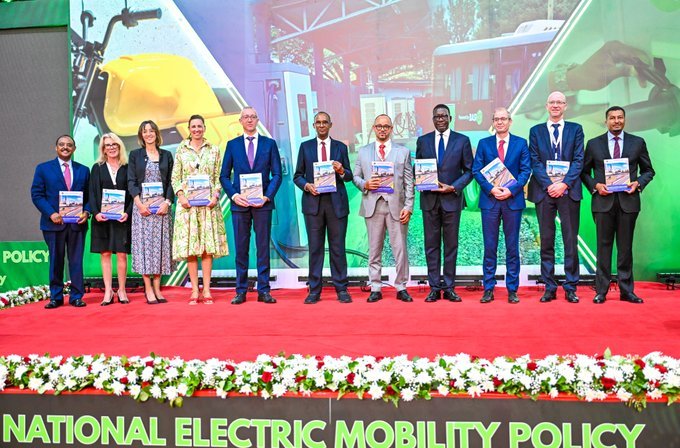
The Government of Kenya has officially launched the National Electric Mobility (e-Mobility) Policy, a comprehensive strategy designed to accelerate the country’s transition to a cleaner, more efficient and low-carbon transport system.
The policy was unveiled at the Kenyatta International Convention Centre (KICC) by the Cabinet Secretary for Roads and Transport, Mr. Davis Chirchir, EGH, who described the initiative as a major step toward modernising Kenya’s transport sector while advancing climate and energy goals.

Kenya’s electric mobility sector has recorded rapid growth in recent years. Between 2022 and 2025, electric vehicle (EV) registrations increased by approximately 2,700 per cent, rising from 1,378 units to 39,324. The expansion has been driven largely by the boda boda (motorcycle taxi) segment, supported by asset financing models and increasing demand for affordable green technologies.
ALSO READ: NIGERIA NCAA, FAAN INTENSIFY STAKEHOLDER COORDINATION AHEAD OF APRIL ICAO VALIDATION
As part of the rollout, the Cabinet Secretary also launched green reflective number plates exclusively for fully electric vehicles, providing a distinct identity for zero-emission transport on Kenyan roads.
To support large-scale adoption, the government has embedded strong fiscal incentives in the Finance Bill 2025. These include zero-rating of Value Added Tax (VAT) on electric buses, electric bicycles, electric motorcycles and lithium-ion batteries, as well as the removal of excise duty on electric bicycles, electric motorcycles and batteries.
Beyond fiscal measures, the policy mandates infrastructure development to support EV uptake. New building guidelines encourage, and in some cases require, commercial developments to allocate at least five per cent of parking spaces for electric vehicle charging facilities.
The National e-Mobility Policy provides a unified framework covering all transport modes. By leveraging Kenya’s abundant renewable energy resources, the government aims to modernise the transport sector and cut greenhouse gas emissions by 32 per cent by 2030, reinforcing the country’s commitment to sustainable development and climate action.