



































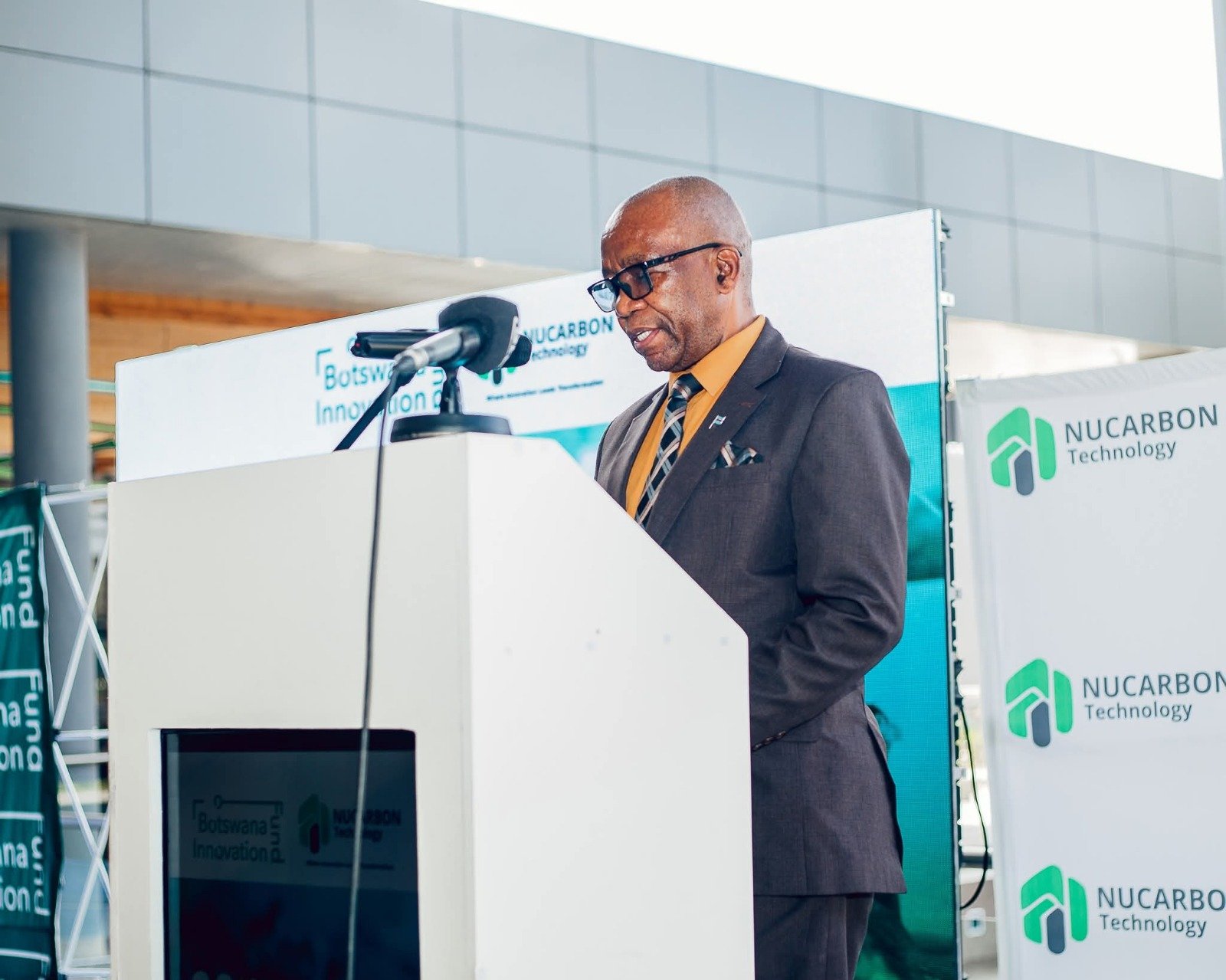
Botswana has taken a significant step toward building a circular, knowledge-based economy with the launch of the NuCarbon Containerized Pyrolysis Plant at the Botswana International University of Science and Technology (BIUST), presided over by the Honourable Shawn Ntlhaile, Assistant Minister of Communications and Innovation.
The plant, developed with a P1,498,900 investment from the Botswana Innovation Fund (BIF), uses pyrolysis technology — a process that heats organic material in the absence of oxygen — to convert poultry litter into biodiesel, biochar, pyrolytic acid, light fuel oil, and surplus electricity. The technology addresses a growing waste management challenge in Botswana’s expanding poultry sector while simultaneously generating commercially valuable outputs, effectively closing the loop in the agricultural value chain.

ALSO READ: KENYA BOLSTERS YOUTH-LED DIPLOMACY, DEEPENS AFRICA–FRANCE DIALOGUE AT 25TH KMUN
What makes the NuCarbon story particularly compelling is its origins. The technology was conceptualised by Daniel Botha, a NuCarbon Technology shareholder, during his undergraduate studies at BIUST — the very institution where it was launched. For Minister Ntlhaile, that arc from student project to government-backed industrial technology was precisely the kind of innovation pathway Botswana needs to replicate.
“Research conducted in our universities, supported through innovation funding, ultimately develops into technologies serving industry and society,” he said at the event, which brought together academic leaders, government officials, innovators, and private sector players including fellow NuCarbon shareholder Mr. Michael Mogopa.

The launch also demonstrated the practical value of what Ntlhaile described as the “Triple Helix” model — the structured collaboration between academia, government, and the private sector that underpins Botswana’s innovation framework. From BIUST’s research environment to BIF funding to private sector commercialisation, the NuCarbon project has traversed every stage of that model and arrived at proof of concept.
It will not stop there. The Minister confirmed that the project has been approved for acceleration under the Botswana Economic Transformation Programme (BTEP), which will support its transition from a demonstration unit to large-scale commercial deployment. The implications for Botswana’s poultry industry — and its broader environmental agenda — are substantial, particularly as waste management pressure grows alongside sector expansion.
“Today’s launch is not the end of the journey; it is the beginning of the next chapter,” Ntlhaile said. The remark captured a wider ambition: Botswana, a country historically dependent on raw commodity exports, is actively repositioning itself as a technology creator — one that develops, owns, and exports intellectual property rather than simply extracting natural resources.