





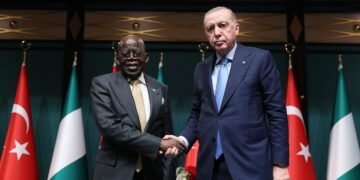




















Bola Ahmed Tinubu on Tuesday unveiled the Nigeria Industrial Policy 2025, directing ministries, departments and agencies (MDAs) to ensure its speedy implementation, stressing that “policies rarely fail at conception but at execution.”
Speaking at the launch held at the Bola Ahmed Tinubu International Conference Centre in Abuja, represented by Vice President Kashim Shettima — the President described the policy as a roadmap to re-engineer Nigeria’s industrial base, unlock value across sectors, and prioritise production, competitiveness and job creation.

ALSO READ: NCS, MILITARY DEEPENS SECURITY ALLIANCE IN NORTH EAST
He acknowledged longstanding challenges, including fragmented value chains, high production costs, infrastructure gaps, policy inconsistency and weak coordination between government and industry, declaring: “This stops now.”
“Industrialisation is not a wish you think about; it is an action you perform,” Tinubu said, emphasising the need for coherence across energy, trade, infrastructure, finance, skills and innovation, as well as strong public-private partnerships.
According to him, the administration will measure success not by policy documents but by “the number of factories that open their gates at dawn, the jobs created, the exports that leave our ports bearing the mark of Nigerian excellence, and the value retained within our economy.”

He said the policy focuses on strategic sectors aligned with Nigeria’s comparative advantages, deepens value chain development to move from raw material exports to finished goods production, integrates micro, small and medium enterprises (MSMEs), aligns infrastructure and energy with industrial growth, and strengthens skills, technology and innovation.
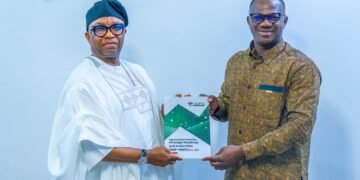
Tinubu commended the Minister of State for Industry, John Owan Enoh, for what he described as disciplined leadership and clarity of purpose, praising the ministry’s technical teams and stakeholders for producing a practical and experience-driven document.
Earlier, Enoh described the policy as a turning point aimed at building an industrial Nigeria “that produces, competes and prospers.”
Chairman of Dangote Group, Aliko Dangote, welcomed the initiative, stating that Nigeria is the only African country where the private sector is larger than government. He expressed optimism that the naira could strengthen to ₦1,000 per dollar this year, citing foreign exchange stability and reforms attracting investors, but stressed that indigenous industries must be protected to thrive.

United Nations Resident and Humanitarian Coordinator in Nigeria, Mohamed Malick Fall, said the policy marks a decisive step toward inclusive growth, noting it stems from collaboration between Nigeria and the United Nations Industrial Development Organization to position the country as a key player in regional and global value chains.
Similarly, President of the Manufacturers Association of Nigeria, Otunba Francis Meshioye, pledged manufacturers’ support for effective implementation, particularly the policy’s emphasis on promoting indigenous entrepreneurship.